



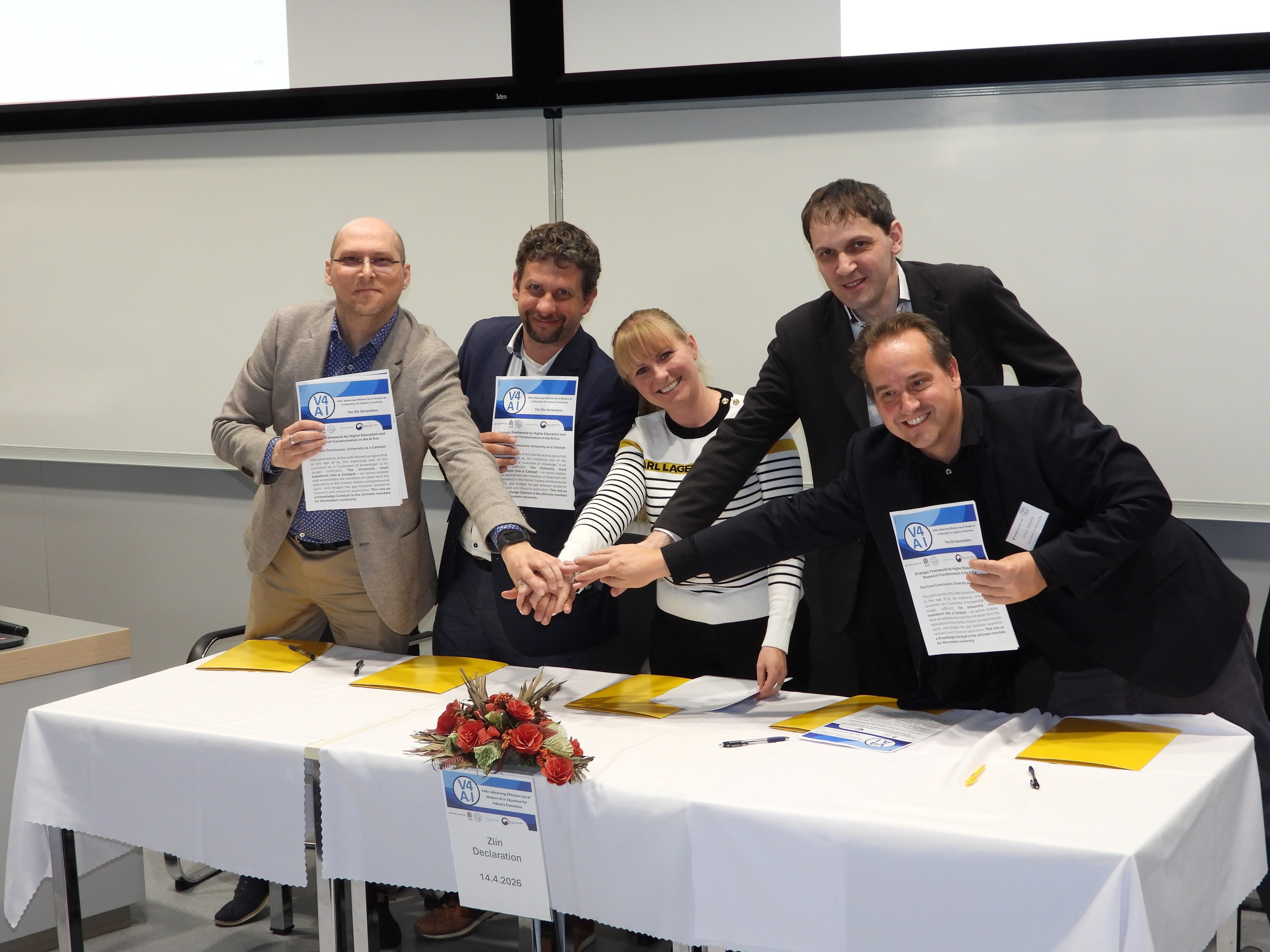




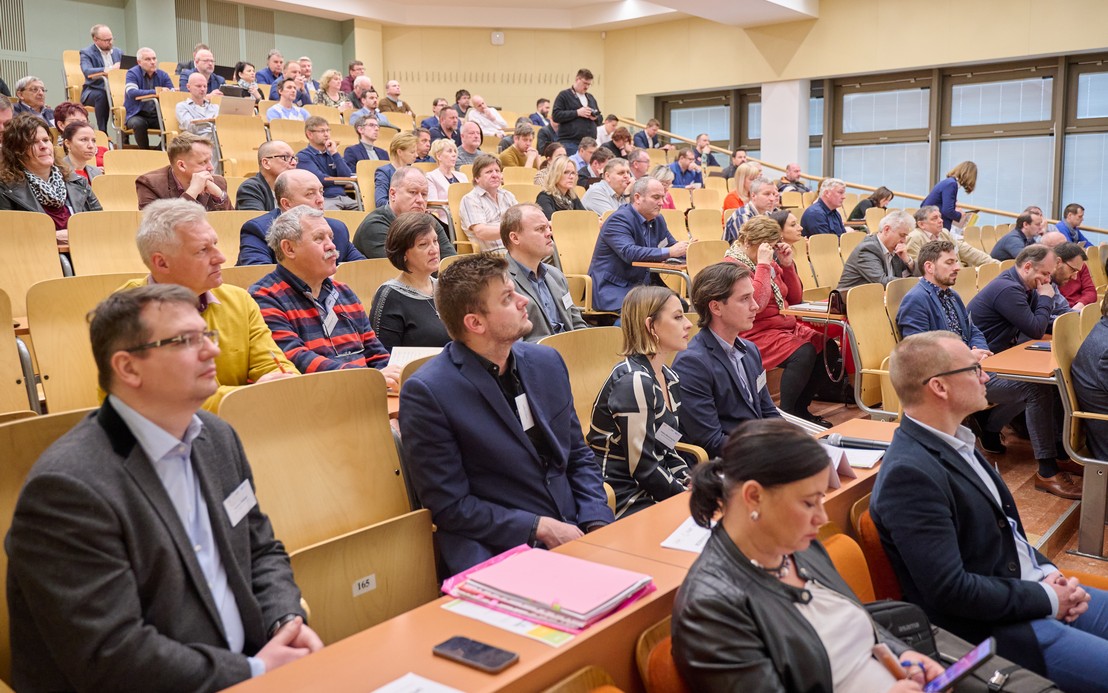
The workshop was attended by a hundred leading academics, researchers, representatives of innovation centers, and technology business leaders from the Visegrad Four countries. Among the key figures whose visions shaped the discussion were, for example:
- David Pavlík, a global technology leader (formerly of SpaceX, Tesla, and ShipMonk), who brought the drive of the startup world to the academic environment.
- Lukáš Rudy, CEO of UNICO MODULAR and founder of the UNICO Innovation Hub, who identified the barriers within innovation ecosystems.
- Balázs Horváth, an expert in the re-engineering of educational systems from SMADS.
- Paweł Skruch, a professor at AGH University of Science and Technology in Kraków, who addressed the topic of industrial standards and AI certification.
- Tereza Malíková, coordinator of the AI Factory at the IT4Innovations National Supercomputing Center.
The aim of the workshop was not only to identify current challenges but, above all, to create a concrete strategic document that would serve as a guide for the modernization of institutions in the region. The result of these discussions is the Zlín Declaration 2026, a detailed elaboration of which can be found in the following sections of this report.
1. The University as a Catalyst: A New Identity in the Era of the Post-Lexical Monopoly
For millennia, the role of the university has been defined as that of a “guardian of knowledge.” Institutions held exclusive access to information through libraries, specialized archives, and expert resources. However, as Balázs Horváth declared in his vision “Reengineering Education,” this “lexical monopoly” has definitively collapsed. Now that information is digitized and immediately accessible through LLMs (large language models), the distribution of facts is no longer a source of added value for universities.
For universities in the V4 region to survive, they must transform into Knowledge Catalysts. In chemistry, a catalyst accelerates a reaction without being consumed itself. In an academic setting, this means that the university creates conditions for high-frequency interactions between human talent, technological infrastructure, and real-world market challenges. The value of education is shifting from the quantity of memorized facts to the quality of the network (Network Nexus) and the speed with which a student can transform a theoretical concept into an applicable prototype. In this system, a mentor does not exist to teach formulas, but to demonstrate how these formulas fail in the real world and how to modify them using AI.
2. Overcoming the Transformation Valley and Building Intangible Capital
The introduction of AI is accompanied by a phenomenon that Martin Mikeska refers to as the “transformation valley” (the J-curve of productivity). A historical parallel with the IT paradox of the 1980s shows that massive investments in technology alone do not guarantee growth. There is often an initial decline in performance because organizations are not prepared for process changes. The key to overcoming this valley is not purchasing more powerful chips, but investing in intangible capital.
This capital includes new organizational workflows, specific employee skills, and a data-driven culture. The strategic focus of the declaration is to strengthen the region’s absorption capacity. We must realize that digitalization is not a technical project, but a socio-organizational transformation. If a university has a supercomputer but lacks the processes to integrate it into teaching and collaboration with SMEs, resources are being wasted. Our task is therefore to educate leaders who can use AI to redesign entire industries, not just to automate existing inefficiencies.
3. Eliminating Naive Replication: Market Purpose First
Lukáš Rudy defined the “nine circles of innovation hell,” with the first being the “sin of ignorance”—blindly copying innovation hubs from the US or Scandinavia without regard for the local context. Stolen blueprints won’t build a house. Every ecosystem must be rooted in the unique DNA of the place. For Zlín and the V4 region, this DNA is a combination of deep industrial tradition (the Baťa legacy), technical skill, and a high degree of improvisation.
The Declaration therefore advocates the principle of Market Purpose First. If no one is willing to pay for a solution, it has no place in the ecosystem. Innovation must not depend on public grants as its primary source of survival, but must be driven by market demand. We are building a modular infrastructure that is adaptable and focused on real-world prototyping. Our goal is not to create a “second Silicon Valley,” but a technologically sovereign and economically sustainable region that leverages its historical roots to build a modern future.
4. Radical Adaptation and Technological Optimism
The world is not undergoing linear change, but exponential disruption. As David Pavlík emphasized, there is a race between the speed of technology and the slowness of institutions. We view AI as leverage that enables the impact of an individual or even a small team to be radically scaled. In our view, technological optimism is not blind faith, but an active determination to use AI tools to strengthen our position in the global market.
The priority is fostering a culture of rapid experimentation and a “beta version” mindset. Universities must abandon rigid five-year plans and enable students and researchers to build projects that can immediately compete with the world’s best. Adaptability means the ability to abandon dysfunctional models and immediately adopt new frameworks. Students must not be passive consumers, but active creators who understand AI as a tool for eliminating routine tasks and freeing up space for creative and strategic tasks with high added value.
5. Industrial Purity: From Probability to Determinism
There is a gap between academic research and industrial requirements. Paweł Skruch pointed out that industry cannot work with “black boxes” that function only 90% of the time. In critical infrastructure, manufacturing, or the automotive sector, determinism, safety, and certifiability are required. Academic models based on probability must be transformed into robust engineering solutions.
Our research will focus on explainable AI (XAI) and algorithm transparency. Industrial AI must be predictable and understandable to human operators. We want to build bridges between theoretical computer science and engineering practice, where the university serves as a validation authority. The goal is to ensure that deployed solutions are not only “smart” but, above all, reliable and safe. This includes simulation-driven development and the use of digital twins for safe, real-time AI testing.
6. Re-engineering Education: Challenge-Based Learning (CBL)
Traditional lectures and memorizing facts are outdated in the AI era. Balázs Horváth and Ľubomír Antoni propose replacing lexical testing with the Challenge-Based Learning (CBL) method. Students do not solve textbook examples, but rather “wicked problems” provided directly by industry partners. The unit of value is no longer what the student knows, but what they can do with what they know using AI.
In this process, AI does not function as a crutch for cheating, but as an accelerator for research and synthesis. The educator becomes a mentor who guides the student through the process of critically evaluating the machine’s outputs. We assess complex problem-solving, the ability to navigate information networks, and creative synthesis. In this way, the university opens its doors to industry and integrates real-world practice directly into the core of the educational process. Graduates thus become fully-fledged experts prepared for a dynamic job market.
7. Automation of Discovery: The Role of the Architect and the EASE Platform
The technological pillar of the declaration is Adam Viktorín’s vision of automating research itself. AI is no longer just an assistant for writing text but is becoming an autonomous tool for discovering algorithms. The EASE (Evolutionary Automated Software Engineering) project demonstrates that the role of the programmer is shifting toward that of a systems architect. Instead of manual coding, students learn to define specifications and benchmarks for AI systems, which then perform thousands of development iterations in the background.
This shift requires new skills: the ability to design experiments, critically evaluate generated iterations, and integrate various AI models into functional units. We are integrating these advanced frameworks into our curriculum so that our graduates are not merely users of AI, but architects capable of automating development cycles and pushing the boundaries of technological possibilities. The EASE platform symbolizes our commitment to technological independence and innovation in the V4 region.
8. The Human Element: Ethics, Empathy, and Bearers of Meaning
While AI excels in speed and precision, only human intelligence is the bearer of meaning, empathy, and ethics. Ľubomír Antoni noted that technology has never changed the value of human beings. Education in the AI era must focus on developing abilities that are beyond the reach of machines: critical thinking, ethical decision-making, and strategic synthesis. AI must augment human intelligence, not replace it.
We will teach students to ask “Why?”, while leaving it to AI to answer “How?”. Ethics is not a brake on innovation, but its compass. Responsible deployment of AI requires an understanding of risks, such as model hallucinations or biases in data. Our goal is to educate a generation of experts who will master technology with a deep sense of social responsibility and ethical sovereignty.
9. Institutional Agility and Curricular Flexibility
The speed of technological change requires a radical reform of how universities operate. Bartłomiej Moniak highlighted the need for agile adaptation of curricula. We cannot wait years for accreditation when technology changes within months. We will introduce modular and flexible study paths that enable the immediate integration of new AI tools and interdisciplinary collaboration (e.g., AI in law, medicine, or design). The university must become an agile organization capable of responding to market needs in real time.
10. Infrastructure Synergies: AI Factories and Living Labs
The final pillar is the effective use of cutting-edge infrastructure. Tereza Malíková presented the concept of the AI Factory as a gateway to IT4Innovations’ supercomputing power. This infrastructure must be accessible not only to researchers but also to students and small businesses. We will build Living Labs—live laboratories where ideas are tested directly in industrial operations. This closes the loop between research and practice, creating a functional “Triple Helix” model (university-state-industry) that forms the foundation of the region’s prosperity.
CONCLUSION: FROM MANIFESTO TO REALITY
The Zlín workshop clearly demonstrated that the V4 region possesses a unique combination of cutting-edge infrastructure (AI Factories, IT4I), academic depth, and industrial tradition. However, the main obstacle remains “asymmetric readiness” and clinging to outdated educational models. As stated in the key conclusion: The university must no longer be an archive, but a catalyst.
The success of the Zlín Declaration will not be measured by the number of signatories, but by the number of procedural changes we implement in our institutions. The transition to a “knowledge catalyst” model requires the courage to admit that some traditional teaching methods are ineffective in the AI era, and a willingness to integrate entrepreneurship directly into the DNA of the academic world.